
 英语
英语 俄语
俄语Content
- 1 What Is a Disc Stack Centrifuge and Why It Is Used
- 2 Working Principle of a Disc Stack Centrifuge
- 3 Types of Disc Stack Centrifuges
- 4 Industrial Applications of Disc Stack Centrifuges
- 5 Key Performance Factors Affecting Separation Efficiency
- 6 How to Select the Right Disc Stack Centrifuge
- 7 Maintenance and Operational Best Practices
- 8 Conclusion: Practical Value of Disc Stack Centrifuge Technology
What Is a Disc Stack Centrifuge and Why It Is Used
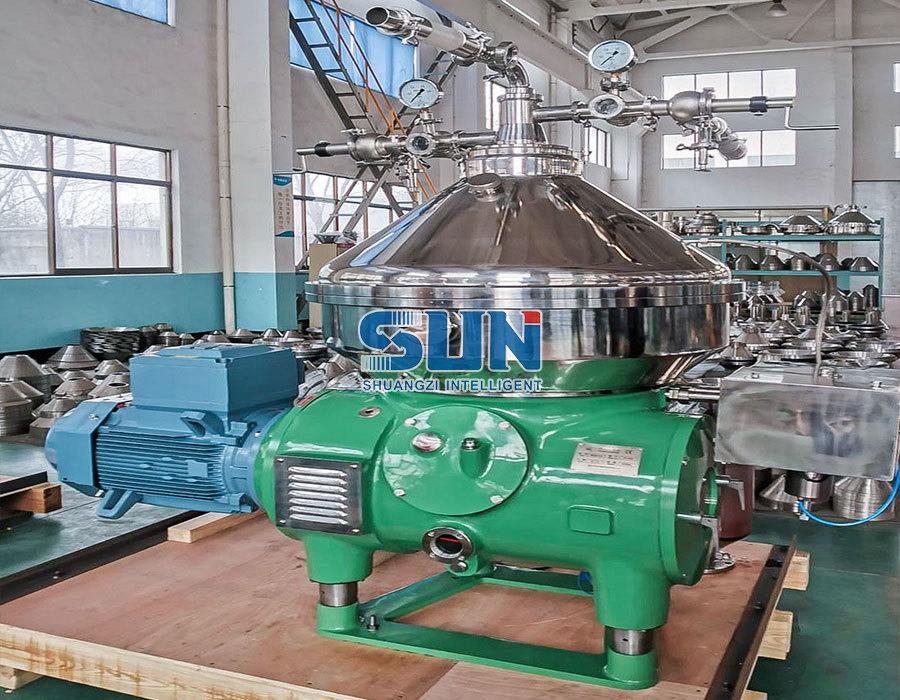
A disc stack centrifuge is a high-speed industrial centrifuge designed for continuous separation of liquids and solids with different densities. It uses a vertical bowl containing a stack of conical discs that significantly increase the effective settling area. This structure allows the centrifuge to achieve rapid and precise separation even when dealing with fine particles or emulsions that are difficult to process with conventional filtration or gravity settling methods.
Disc stack centrifuges are widely used in industries that require high clarification efficiency, stable operation, and compact equipment footprints. Typical use cases include liquid-solid separation, liquid-liquid separation, and three-phase separation involving oil, water, and solids. Their ability to operate continuously makes them suitable for large-scale industrial processes where downtime must be minimized.
Working Principle of a Disc Stack Centrifuge
The working principle of a disc stack centrifuge is based on centrifugal force, which can be several thousand times greater than gravity. When the mixture enters the rotating bowl, it is accelerated to high rotational speed. Due to density differences, heavier components move outward toward the bowl wall, while lighter components migrate inward toward the center.
The disc stack plays a critical role in separation efficiency. Each disc creates a thin separation channel, shortening the settling distance for particles. This allows even micron-sized solids to separate effectively within milliseconds. Clarified liquid flows upward along the discs and exits through designated outlets, while separated solids accumulate at the bowl periphery.
Key Mechanical Components
- High-speed rotating bowl that generates centrifugal force
- Conical disc stack that increases separation surface area
- Inlet distributor ensuring smooth feed acceleration
- Solids discharge system, either manual or automatic
Types of Disc Stack Centrifuges
Disc stack centrifuges are available in several configurations depending on the separation task. Selecting the correct type directly affects separation efficiency, product quality, and operating cost.
| Type | Function | Typical Applications |
| Clarifier | Liquid-solid separation | Beverages, chemicals, pharmaceuticals |
| Separator | Liquid-liquid separation | Oil purification, fuel processing |
| Purifier | Three-phase separation | Edible oil, biodiesel, marine fuel |
Industrial Applications of Disc Stack Centrifuges
Disc stack centrifuges are essential in many industrial processes due to their high separation efficiency and continuous operation. They are particularly effective when dealing with low solid concentrations or emulsified liquids.
Food and Beverage Processing
In food and beverage production, disc stack centrifuges are used for juice clarification, dairy separation, beer clarification, and edible oil refining. Hygienic design and stainless steel construction ensure compliance with food safety standards while maintaining product quality and yield.
Chemical and Pharmaceutical Industries
Chemical and pharmaceutical manufacturers use disc centrifuge separators to remove fine catalysts, recover valuable intermediates, and clarify reaction mixtures. Precise control of separation parameters helps maintain consistent product purity and reduces downstream filtration load.
Energy, Oil, and Environmental Applications
In oil and energy sectors, disc stack centrifuges are used for fuel oil purification, lubricating oil cleaning, and biodiesel processing. Environmental applications include wastewater treatment, sludge thickening, and recovery of reusable process water.
Key Performance Factors Affecting Separation Efficiency
Several operational and design parameters determine the performance of a disc stack centrifuge. Understanding these factors helps operators optimize throughput and separation quality.
- Bowl speed and generated centrifugal force
- Disc spacing and disc angle design
- Feed flow rate and viscosity of the mixture
- Density difference between phases
How to Select the Right Disc Stack Centrifuge
Choosing the correct disc stack centrifuge requires a clear understanding of process requirements. Factors such as feed composition, desired clarity, operating temperature, and automation level should be evaluated during selection.
For processes with frequent solids accumulation, self-cleaning disc centrifuges with automatic sludge discharge can significantly reduce maintenance time. For applications requiring maximum clarification, a clarifier with optimized disc geometry and high rotational speed may be more suitable.
Maintenance and Operational Best Practices
Proper maintenance ensures stable performance and extends the service life of a disc stack centrifuge. Regular inspection of seals, bearings, and disc stacks helps prevent vibration issues and separation inefficiencies.
Operators should also monitor inlet conditions and avoid sudden flow or temperature changes. Consistent operating parameters improve separation reliability and reduce wear on critical components.
Conclusion: Practical Value of Disc Stack Centrifuge Technology
A disc stack centrifuge is a proven solution for high-efficiency industrial separation. Its compact design, continuous operation, and ability to handle fine particles make it indispensable across food, chemical, pharmaceutical, and energy industries. By understanding its working principles, application scope, and selection criteria, operators can achieve stable performance, lower operating costs, and consistent product quality.