
 英语
英语 俄语
俄语Content
- 1 What Is a Falling Film Evaporator and How Does It Work
- 2 Falling Film vs. Other Evaporator Types: Where Each Fits
- 3 Single, Double, and Triple Effect Configurations Explained
- 4 Critical Design Parameters That Affect Performance
- 5 Typical Industries and Applications
- 6 How to Choose the Right Falling Film Evaporator for Your Process
- 7 Common Operating Problems and How to Prevent Them
- 8 Our Falling Film Evaporator Products and Manufacturing Capabilities
What Is a Falling Film Evaporator and How Does It Work
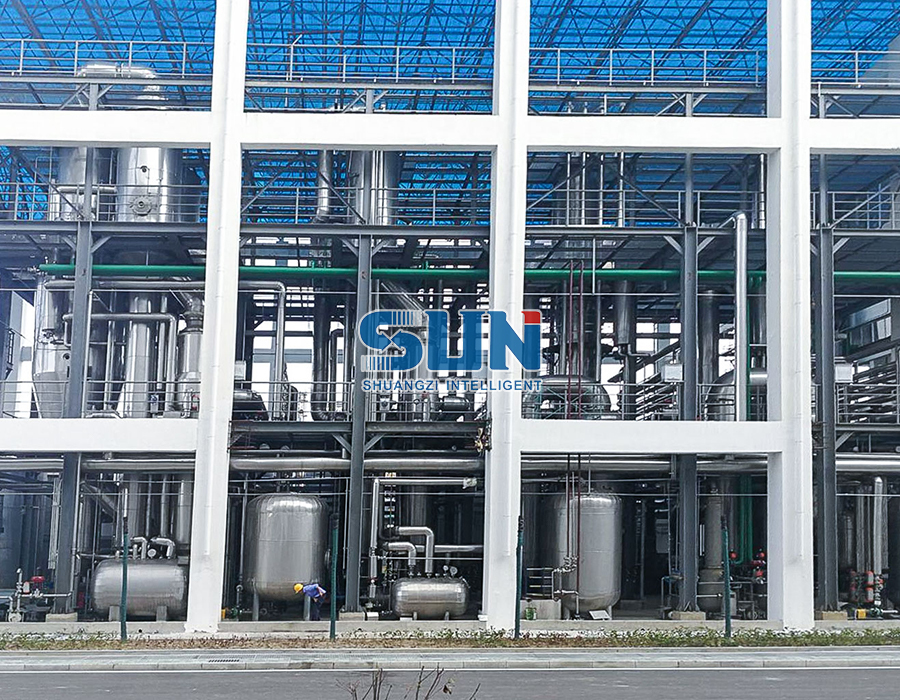
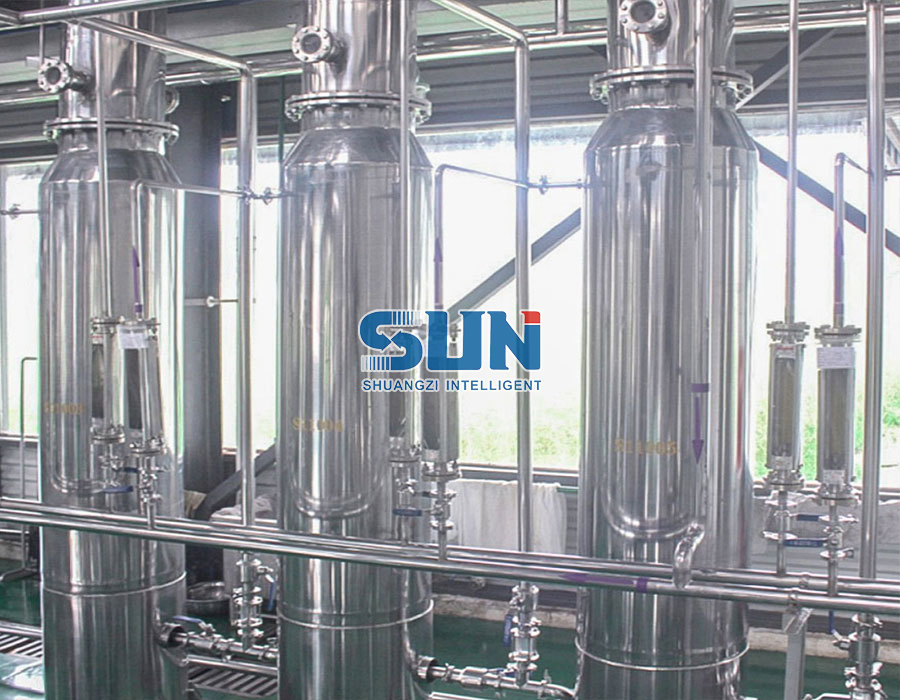
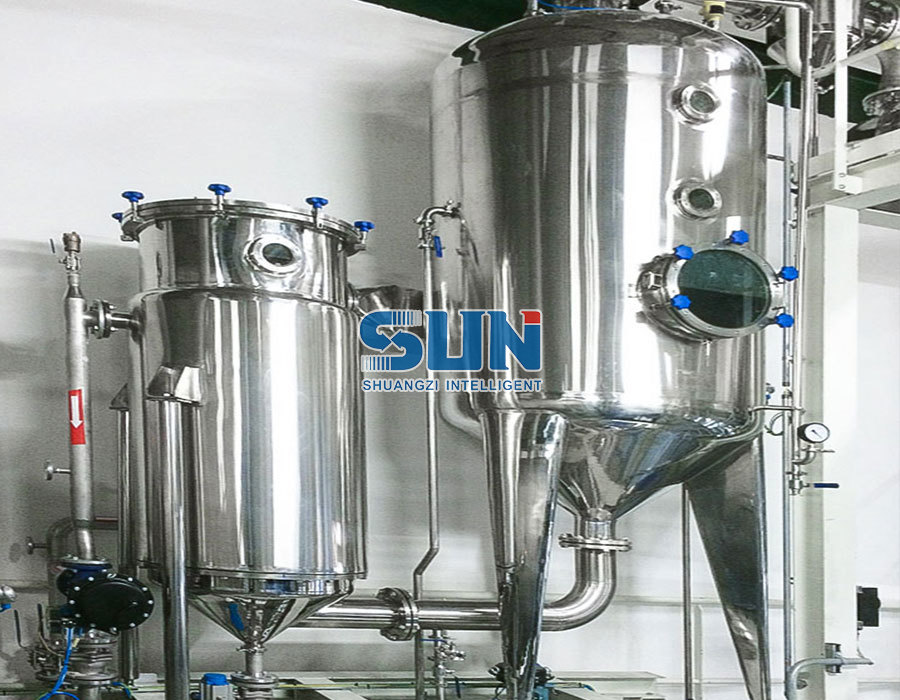
A falling film evaporator is a vertical shell-and-tube heat exchanger in which liquid is distributed at the top of the heating tubes, flows downward as a thin film along the inner tube walls under gravity, and evaporates continuously as it descends. The resulting vapor and concentrated liquid exit together at the bottom of the tubes into a separator, where they are split. The condensed vapor is recovered, and the concentrated product is discharged for further processing or drying.
What makes this design distinctly efficient is the extremely short liquid residence time — typically just 5 to 30 seconds inside the heating zone — and the very low temperature difference required between steam and product, often as low as 3–5 °C. These two characteristics make the falling film evaporator the preferred choice wherever the processed liquid is heat-sensitive, viscosity-limited, or subject to fouling under prolonged exposure to heat.
Key Components of a Falling Film Evaporator
- Liquid distributor (top distribution device): Ensures even spreading of feed liquid onto all tubes simultaneously. Poor distribution is the single most common cause of dry spots, scaling, and reduced evaporation efficiency.
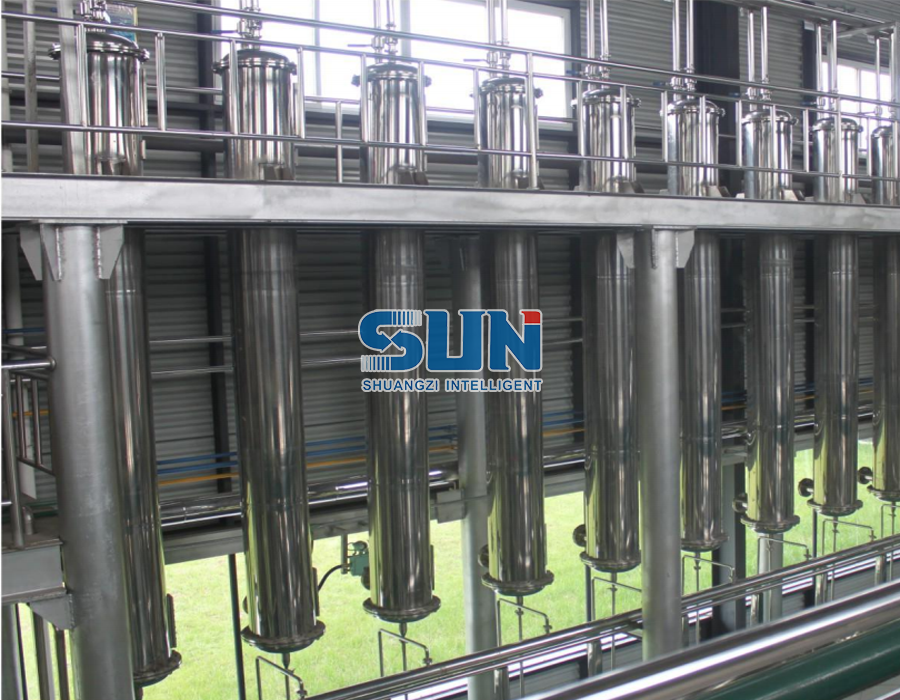
- Vertical heating tubes: Standard diameters range from 25 mm to 65 mm; tube length is typically 4–8 m. Longer tubes increase the evaporation surface without expanding footprint.
- Shell-side steam supply: Low-pressure steam (0.05–0.3 MPa gauge) circulates on the shell side and condenses, releasing latent heat to the falling liquid film.
- Vapor-liquid separator: A tangential or centrifugal separator at the tube bottom removes entrained droplets from the vapor stream before the vapor enters the next effect or condenser.
- Condenser and vacuum system: In most pharmaceutical and herbal extract applications, a surface condenser plus vacuum pump maintains operating pressure at 5–30 kPa, enabling evaporation temperatures of 40–70 °C to protect active compounds.
Falling Film vs. Other Evaporator Types: Where Each Fits
Buyers often compare falling film evaporators against rising film, forced circulation, and scraped-surface designs. Understanding the operating boundaries of each type helps avoid costly mismatches between equipment and process.
| Evaporator Type | Typical Feed Viscosity | Residence Time | Heat Sensitivity | Typical Application |
|---|---|---|---|---|
| Falling Film | < 200 mPa·s | 5–30 s | Excellent | Herbal extracts, dairy, fruit juice, APIs |
| Rising Film | < 100 mPa·s | 1–3 min | Good | Low-viscosity dilute solutions |
| Forced Circulation | Up to 5,000 mPa·s | 5–15 min | Moderate | Crystallization, salting solutions |
| Scraped Film (Thin Film) | Up to 50,000 mPa·s | < 10 s | Excellent | High-viscosity, heat-sensitive pastes |
The falling film design occupies a practical sweet spot: it handles the vast majority of low-to-medium viscosity feed streams with superior energy efficiency and product quality protection, while remaining mechanically simpler and more cost-effective than scraped-film units.
Single, Double, and Triple Effect Configurations Explained
The number of "effects" refers to how many times the latent heat of evaporation is reused within the same system. In a single-effect falling film evaporator, steam heats the first (and only) effect, and the vapor produced is sent directly to a condenser and discarded. In a multi-effect arrangement, the vapor from the first effect becomes the heating medium for the second effect, and so on.
Steam Economy as a Selection Criterion
Steam economy — the kilograms of water evaporated per kilogram of steam consumed — improves almost linearly with the number of effects:
- Single effect: Steam economy ≈ 0.8–1.0 kg/kg. Suitable for small-capacity plants (< 500 L/h evaporation) or where steam cost is low.
- Double effect: Steam economy ≈ 1.6–1.9 kg/kg. Most common choice for mid-scale pharmaceutical and herbal extract operations (500–5,000 L/h evaporation). Capital payback from energy savings is typically 12–24 months versus single effect.
- Triple effect: Steam economy ≈ 2.4–2.7 kg/kg. Justified for large-scale continuous production (> 5,000 L/h) such as industrial plant extract concentration lines or food processing plants.
A practical example: a plant running 3,000 L/h of aqueous herbal extract that switches from single to double effect can reduce steam consumption by roughly 45–50%, translating to a measurable reduction in annual energy costs at typical industrial steam prices.
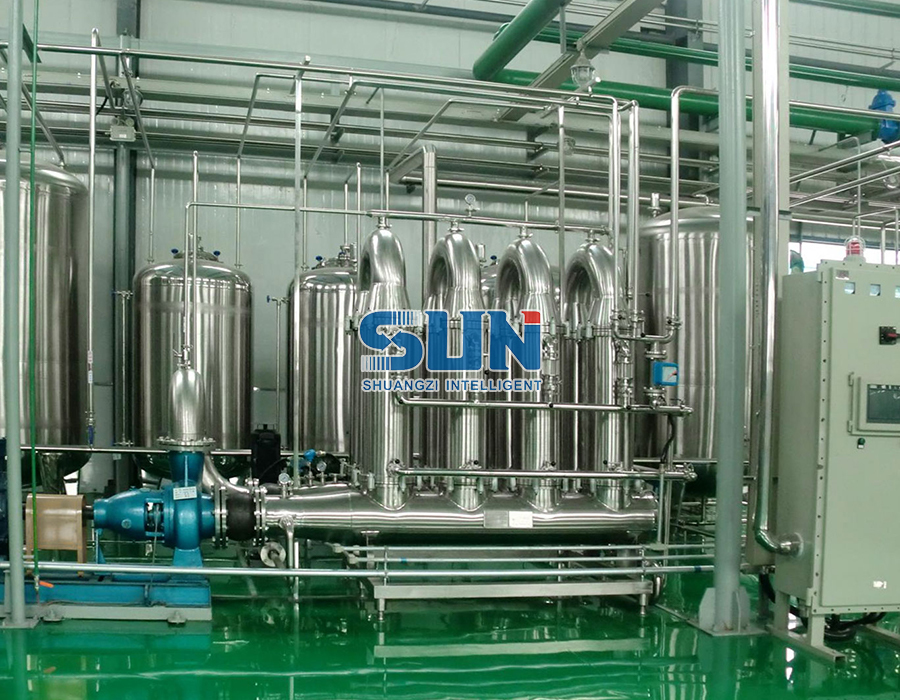
We manufacture single-effect, double-effect, and triple-effect falling film evaporators across a wide capacity range. You can explore our full range on our evaporation concentration machine product page.
Critical Design Parameters That Affect Performance
When evaluating a falling film evaporator specification sheet, several parameters determine whether the unit will actually perform as expected in your process. These are the ones we consistently pay closest attention to when engineering a unit for a client.
Liquid Distribution Quality
Even liquid distribution across all tubes is non-negotiable. If even 5–10% of tubes receive insufficient feed, those tubes run dry, fouling builds up rapidly, and overall heat transfer coefficients drop. High-quality distributors — whether perforated plate, notched weir, or spin-type — are engineered to maintain uniform film formation even during partial-load operation (down to 30–40% of design flow).
Operating Pressure and Temperature
For heat-sensitive products such as botanical extracts, amino acids, or fermentation broths, operating under vacuum (5–20 kPa absolute) reduces boiling temperature to 40–60 °C, effectively preventing thermal degradation of active ingredients. The vacuum system design — whether water ring pump, steam ejector, or dry pump — must be sized for the non-condensable gas load, not just the vapor load.
Overall Heat Transfer Coefficient (U-value)
For a thin falling film of a low-viscosity liquid on a clean stainless steel surface, U-values typically range from 2,000 to 4,000 W/(m²·K). This is 2–4 times higher than forced circulation designs for the same fluid, which is why falling film evaporators can achieve higher evaporation rates per unit of installed heat transfer area. As concentration and viscosity increase toward the end of the evaporation path, U-values drop — this is why proper sizing must account for the full concentration range, not just the inlet conditions.
Material of Construction
For pharmaceutical-grade and food-grade applications, SUS316L stainless steel is standard for product-contact surfaces due to its corrosion resistance and compliance with GMP requirements. SUS304 is acceptable for non-product-contact structural components. Where aggressive solvents (ethanol, acetone, certain organic acids) are present, additional consideration of welds, gaskets, and sealing material compatibility is essential.
Typical Industries and Applications
Falling film evaporators are not a niche piece of equipment — they are the industry standard concentration unit across multiple sectors precisely because of their combination of energy efficiency, product quality preservation, and operational flexibility.
- Herbal and botanical extraction: Concentrating aqueous or hydroalcoholic extracts of traditional Chinese medicine, CBD, stevia, tea polyphenols, and similar materials. Low-temperature vacuum operation is mandatory to retain bioactive content.
- Pharmaceutical manufacturing: Pre-concentration of API solutions prior to crystallization, spray drying, or lyophilization. GMP-grade units must be CIP (clean-in-place) compatible, with smooth internal surfaces and minimal dead zones.
- Food and dairy processing: Concentration of fruit juices, milk, whey, glucose syrups, and fermentation liquors. The dairy and juice industries are among the largest users of multi-effect falling film evaporators globally.
- Fermentation broth concentration: Post-fermentation concentration of amino acids, organic acids, enzymes, and microbial metabolites before downstream separation steps.
- Chemical and solvent recovery: Recovery of solvents such as ethanol from extraction processes, where the recovered solvent is recycled back into production, substantially reducing operating costs.
- Wastewater treatment: Volume reduction of process effluents prior to disposal or zero-liquid-discharge (ZLD) systems.
How to Choose the Right Falling Film Evaporator for Your Process
Selecting a falling film evaporator requires matching the equipment design to the specific physical and chemical characteristics of your feed stream, your target concentration, and your production volume. A unit optimized for a fruit juice application will not necessarily perform correctly on a viscous herbal extract without design adjustments. Here are the most important selection criteria to work through before specifying equipment.
Step 1 — Define Your Feed and Product Characteristics
You need to know: initial and final concentration (Brix or % solids), feed viscosity at both inlet and outlet concentrations, thermal stability limit of active compounds, and whether the liquid contains suspended solids or prone-to-fouling components. These data points drive nearly every design decision that follows.
Step 2 — Determine Required Evaporation Capacity
Evaporation capacity is expressed in kg/h or L/h of water (or solvent) removed. For example, if you feed 10,000 kg/h of a solution at 5% solids and want to reach 50% solids, you need to evaporate 9,000 kg/h of water. This capacity figure directly determines the required heating surface area and the number of effects that will be economically justified.
Step 3 — Choose the Number of Effects Based on Energy Economics
Use your local steam cost and annual operating hours to calculate the energy savings from adding a second or third effect. As a rule of thumb, each additional effect reduces steam consumption by approximately 40–45% relative to the previous configuration. For facilities running more than 6,000 hours per year, a triple-effect system is almost always cost-justified at evaporation capacities above 3,000 L/h.
Step 4 — Evaluate CIP and GMP Requirements
If your process is pharmaceutical or food-grade, ensure the evaporator is designed for full CIP: smooth internal welds (Ra ≤ 0.8 µm), spray balls in the separator vessel, gravity-drain tube sheets, and compliance with relevant standards (CE, ASME, ISO 9001). Pressure vessel certification requirements vary by country and must be confirmed early in the procurement process.
Step 5 — Consider Automation Level
Modern falling film evaporators can operate in fully automatic mode with PLC/SCADA control, managing feed flow, steam pressure, vacuum level, and product density in real time. Automatic operation reduces operator dependency and improves batch-to-batch consistency, which is particularly important in pharmaceutical and nutraceutical production environments.
Common Operating Problems and How to Prevent Them
In practice, the majority of falling film evaporator performance issues can be traced back to a small number of root causes. Knowing these in advance helps both in equipment selection and in day-to-day operations.
- Uneven film distribution and dry-out: Caused by feed flow below minimum wetting rate, blocked distributor holes, or tube-sheet fouling. Prevention: maintain feed flow above 70% of design minimum and schedule regular CIP cycles before visible fouling occurs.
- Foaming: Some protein-containing or surfactant-bearing solutions foam extensively at reduced pressure. Anti-foam dosing or a foam breaker in the separator vessel is the standard countermeasure.
- Scaling and fouling: Calcium salts, proteins, and pectin-rich liquids deposit on tube surfaces, reducing U-values within hours in severe cases. Solutions include regular acid/caustic CIP, operating at lower wall temperatures, or using electropolished tube surfaces to reduce adhesion.
- Vapor carryover into product: Indicates separator undersizing or excessive vapor velocity. A properly designed tangential separator maintains droplet separation efficiency above 99% at design vapor load.
- Vacuum loss: Non-condensable gas buildup, condenser fouling, or vacuum pump wear are the most frequent causes. A scheduled preventive maintenance program on the vacuum system directly prevents unplanned production stoppages.
Our Falling Film Evaporator Products and Manufacturing Capabilities
At Zhejiang Shuangzi Intelligent Equipment Co., Ltd., we have been designing and manufacturing evaporation concentration equipment since 2007. Our falling film evaporators are engineered for pharmaceutical, botanical extraction, bio-fermentation, food, and chemical applications, and are manufactured under ISO 9001 quality management with ASME and CE certification for pressure vessel components.
We supply single-effect, double-effect, and triple-effect falling film evaporators in both standard and fully customized configurations, including SUS304 and SUS316L product-contact materials, fully automatic PLC control systems, and integration-ready designs for turnkey extraction lines. Our equipment has been installed in projects across the United States, Canada, Russia, Kazakhstan, India, Thailand, Malaysia, and more than a dozen other countries.
If you are evaluating evaporation equipment for your process, we invite you to visit our evaporation concentration machine product page to review our current equipment range, or contact our engineering team directly to discuss your specific process requirements.