
 英语
 俄语
Content
- 1 What Biologics Drug Development Has to Deliver
- 2 Upstream: Match the Expression System to the Vessel
- 3 Downstream: Where Cost and Surprises Concentrate
- 4 Scale-Up and Technology Transfer: Define by Mechanism
- 5 The Development Roadmap and Where Capital Is Committed
- 6 Quality, GMP and Documentation
- 7 Frequently Asked Questions
A 200 L single-use bioreactor is running at 4.2 g/L and the pilot team is pleased. Eighteen months later the same clone enters a 2,000 L stainless train, and the disc-stack centrifuge blinds itself within forty minutes of harvest. The molecule did not change. The process did.
Biologics drug development is usually described as a scientific program. By the time a candidate reaches an investigational new drug filing it has also become a capital program: cell line, media, bioreactor geometry, chromatography resin, buffer volumes, clean utilities and fill-finish capacity are committed years before the first commercial batch. Those commitments are expensive to reverse, which is why the equipment conversation belongs in phase one rather than in the engineering phase.
What follows looks at the development path from the process side: what each stage demands from hardware, where scale-up tends to break, and which specifications are worth arguing about early.
A biologic that performs at 200 L is a laboratory result. The same molecule at 2,000 L is a manufacturing process, and it is judged by comparability, not by titer alone.
What Biologics Drug Development Has to Deliver
Biologics drug development is the sequence of discovery, cell-line construction, process and analytical development, and GMP manufacturing that converts a biologically produced molecule into an approved, reproducible medicine.
A biologic is a therapeutic whose active substance is produced by, or derived from, a living system. The category covers recombinant proteins and monoclonal antibodies, vaccines, blood products, cell and gene therapies, and fermentation-derived complex molecules such as human milk oligosaccharides.
Three consequences follow. The product is defined by its process, because glycosylation, aggregation, charge variants and host-cell protein levels all depend on how the cells were grown and how the harvest was handled. Small process shifts can move critical quality attributes, so comparability work after a change is a campaign rather than a memo. And cost of goods is dominated by purification and analytics, not by the fermentation vessel, which is where many early budgets are misplaced.
| Decision area | Small molecule | Biologic |
| Active substance | Chemically synthesised, structurally defined | Produced in a living system, structurally heterogeneous |
| Production route | Multi-step chemical synthesis | Cell culture or microbial fermentation plus purification |
| Critical attributes | Purity, polymorph, chiral form | Glycan profile, aggregation, charge variants, potency |
| Purification burden | Moderate and well modelled | High, including chromatography and viral clearance |
| Storage | Mostly ambient, chemically stable | Often chilled, sensitive to shear and interfaces |
| Post-approval change | Chemistry-led comparability | Process-led comparability with a full analytical panel |
Reading that table backwards is useful for procurement: every row in the biologic column translates into a piece of equipment, a utility, or an analytical method that must exist before clinical supply can be released.
Upstream: Match the Expression System to the Vessel
Upstream development decides whether a process can hold a consistent titer and impurity profile at commercial scale, and that outcome depends on the expression system, the bioreactor, and how closely the two are matched.
Expression platform first, hardware second
Chinese hamster ovary lines still carry most monoclonal antibody programs, microbial systems remain efficient for fragments and simple proteins, and yeast or bacterial fermentation now supports complex products once considered mammalian-only. The choice fixes oxygen demand, shear sensitivity and cleaning regime, so it should precede any vessel quotation.
- Volumetric mass transfer must be demonstrated at the largest scale, not extrapolated from a 10 L glass vessel.
- Power input per volume and impeller tip speed set the shear dose, and they are not interchangeable between vendors.
- Feed, pH and dissolved oxygen loops need enough turndown for high-density fed-batch and for perfusion.
- Sterilisation and cleaning must be validated in place, because a bioreactor that cannot be cleaned reliably becomes a contamination source with a long tail.
Lower capital, fast changeover, well suited to clinical and multi-product suites. Extractables and leachables data, bag integrity testing and supplier qualification are mandatory, and working volumes above roughly 2,000 L become awkward.
Higher capital and longer lead time, but proven at 10,000 L and beyond, with steam sterilisation, repeatable mixing and a cleaning validation package that regulators already understand. Product changeover is the real cost.
At pilot scale the honest question is not which option is modern, but which option survives the clinical timeline. A single-use train can be running in months; a stainless train usually needs a year or more, plus a building prepared around it.
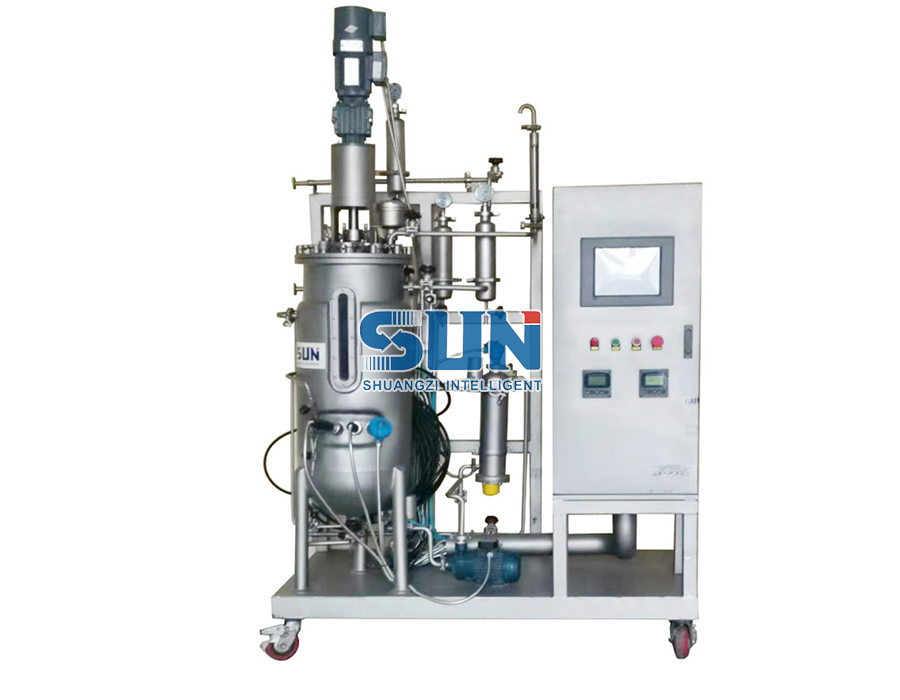 Pilot-Scale Stainless Steel Mechanical Agitated FermenterPilot-scale stainless-steel fermenter for microbial culture, with in-situ sterilization and touchscreen control of temperature, pH, dissolved oxygen, stirring and aeration.View Product →
Whichever route is chosen, the pilot skid should carry the same instrumentation logic as the commercial train, because technology transfer compares data, not intentions.
Downstream: Where Cost and Surprises Concentrate
Downstream processing usually carries the majority of cost of goods for a therapeutic protein, and it is where scale-up surprises appear first.
| Unit operation | Typical equipment | What fails at scale |
| Harvest and clarification | Disc-stack centrifuge, depth filtration | Solids loading, shear damage, cycle time |
| Capture | Affinity or protein A column | Resin compression, flow distribution, resin life |
| Viral inactivation | Low pH hold tank with mixer | Dead zones, pH overshoot, hold time validation |
| Polishing | Anion exchange, hydrophobic interaction | Buffer volume, gradient reproducibility |
| Concentration | Ultrafiltration and diafiltration skid | Flux decay, membrane area, cross-flow limits |
| Bulk storage | Single-use bag or 316L tank | Extractables, freeze-thaw behaviour, hold time |
The binding constraint in most downstream suites is not the column. It is the volume of buffer the plant can prepare and the hold time the product will tolerate while it waits.
Clarification deserves particular attention, because the harvest decision cascades through the whole train. A disc-stack centrifuge handles high solids loading in a compact footprint but exposes cells to shear; depth filtration is gentler and easier to scale down but consumes media and adds a disposable cost line. Many programs run a combination, and the choice should be made with the feed stream in hand rather than from a general preference.
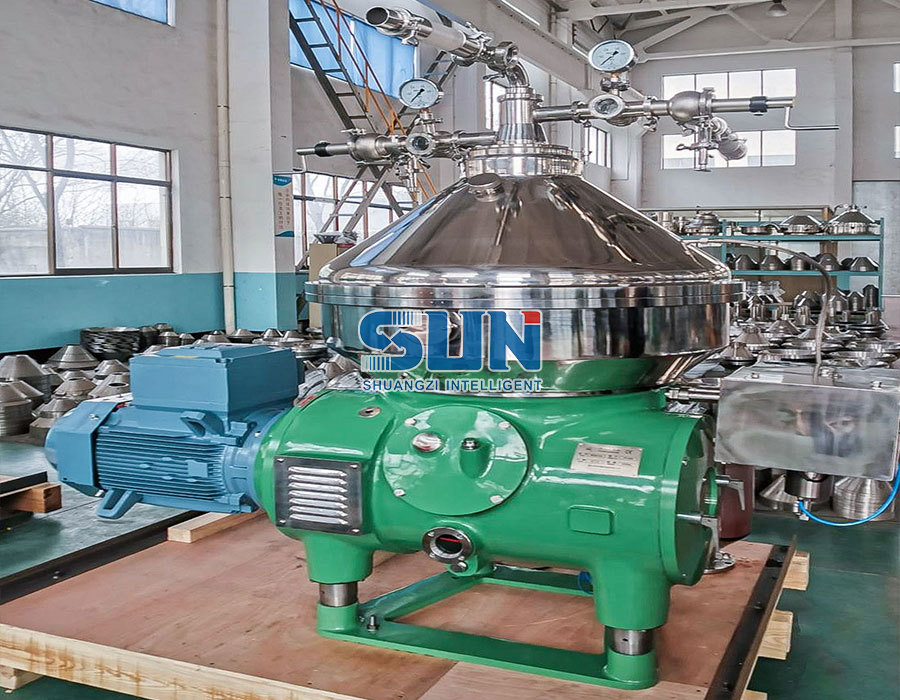 Vertical Disc Stack Centrifuge for Solid-Liquid SeparationHigh-speed vertical disc-stack separator for clarification of herbal extracts and fermentation broth, with stainless-steel contact parts and continuous clarified-liquid discharge.View Product →
Chromatography steps are specified by resin volume and bed height, yet the practical limits appear in buffer preparation, tank capacity, and the time a column may sit between elution and cleaning. Those limits belong in the process description before the skid is ordered.
Scale-Up and Technology Transfer: Define by Mechanism
Scale-up works when the parameters that control quality are understood mechanically, so they can be re-established in a different vessel rather than copied as numbers.
The parameters that travel well are mixing time, oxygen transfer coefficient, power input per volume, tip speed, carbon dioxide stripping and the feed profile. Geometry does not travel, so the same impeller at the same tip speed in a taller vessel gives a different blend time. A qualified scale-down model is therefore the most useful asset a process team can own, because it lets worst-case conditions be tested without consuming commercial capacity.
Two engineering runs are usually enough to confirm a transfer, provided the acceptance criteria are written around product quality and not around a parameter value that happened to work at pilot scale. Where a parameter must shift, the analytical panel and the comparability argument carry the justification.
Equipment selection at this stage deserves the same rigour as the process design, and it helps to review the practical criteria that separate a serviceable fermentation system from a difficult one. A structured checklist for biofermentation equipment selection covers instrumentation, cleanability and documentation in one pass.
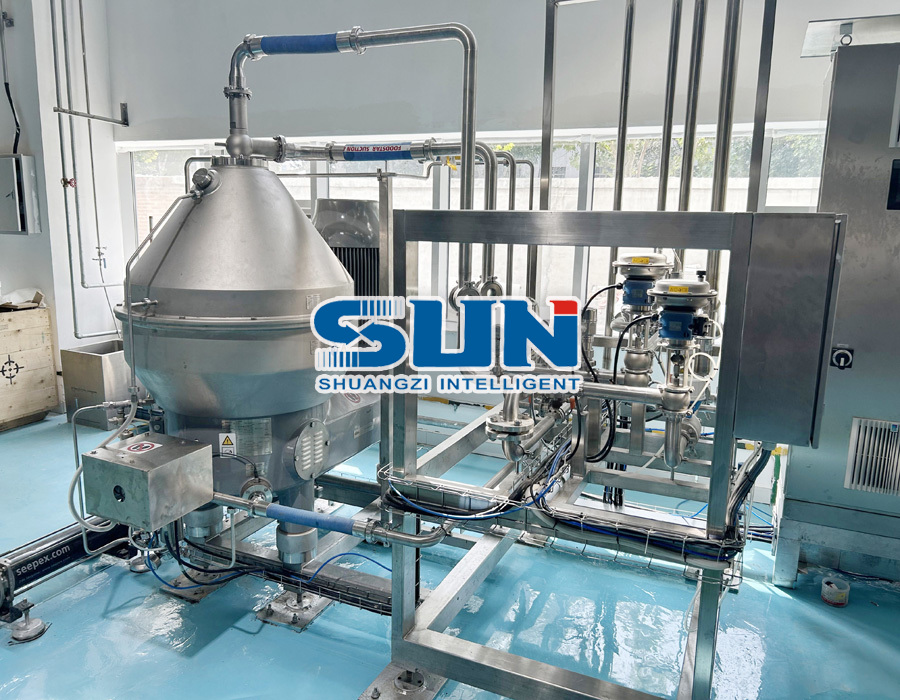 Custom Bio Fermentation Tank System for HMOsCustomizable fermentation system spanning lab to industrial scale, with aseptic design and real-time control of temperature, pH, dissolved oxygen and stirring for microbial production.View Product →
The Development Roadmap and Where Capital Is Committed
Biologics programs pass five recognisable gates, and the largest equipment commitments are usually signed at the second and third, long before pivotal data exist.
Discovery and lead selection
Molecule format, expression host and early analytics. Equipment impact is limited to bench and small pilot hardware.
Cell line and process development
Stable pool or clone selection, media and feed design, small-scale purification. Pilot capacity is usually reserved here.
Phase I and II clinical supply
200 L to 500 L campaigns in a flexible suite. Single-use trains dominate because timeline matters more than unit cost.
Phase III and process performance qualification
Scale-up to 2,000 L or beyond, three consecutive qualification batches, cleaning and hold-time validation.
Filing and commercial supply
Capacity reservations, second-source strategy, and a change control system that absorbs a supplier notice without stopping production.
Pilot capacity built too early is idle capital. Pilot capacity built too late is a delayed trial. A flexible train that can be re-purposed usually costs less than either mistake.
Programs that place several unit operations under one engineering scope tend to shorten commissioning, because piping, instrumentation and cleaning routines are reconciled by one team. Integrated fermentation projects delivered as a single package, such as this biofermentation project reference, show how pilot and production equipment can share a control philosophy from the start.
Quality, GMP and Documentation
In biologics manufacturing, equipment documentation is part of the regulatory submission rather than an after-sales extra.
- Material certificates to EN 10204 3.1 for product contact parts, traceable to heat numbers.
- Surface finish of 0.4 micron Ra or finer on product contact surfaces, verified by measurement rather than by claim.
- Cleaning and sterilisation validation, including coverage testing and drainability checks.
- Data integrity controls aligned with 21 CFR Part 11 and EU Annex 11 for electronic batch records.
- A complete qualification package: FAT, SAT, IQ and OQ protocols with executed reports.
- Change control notification, so a supplier revision does not become an unreported deviation.
Ask for the documentation package before the purchase order is signed, not after the factory acceptance test.
None of this is glamorous, and all of it is inspected. A vessel with a beautiful weld and no heat-number traceability is a finding waiting to be written.
Frequently Asked Questions
How long does biologics drug development take?
From candidate selection to first approval, a biologic typically takes six to ten years. The clinical program occupies four to six of those years, and process validation is concentrated in the final eighteen months. Timelines stretch when pilot capacity is unavailable or when a scale-up change forces a comparability study.
What is the difference between upstream and downstream processing?
Upstream covers everything that grows the cells or organism: cell line, media, seed train, bioreactor and harvest. Downstream covers recovery and purification, including clarification, chromatography, viral inactivation, concentration and formulation.
When should a program move from single-use to stainless steel?
Usually when commercial demand exceeds about 2,000 L per batch, when a product needs steam sterilisation for process or regulatory reasons, or when frequent product changeover is not expected. Below that, the flexibility and lower capital of single-use equipment often win.
Which documents should accompany GMP bioprocessing equipment?
At minimum: material and surface certificates, weld and finish records, instrument calibration certificates, cleaning and sterilisation validation support, an automation functional specification with data integrity provisions, and executed FAT and SAT reports.