
 英语
英语 俄语
俄语Content
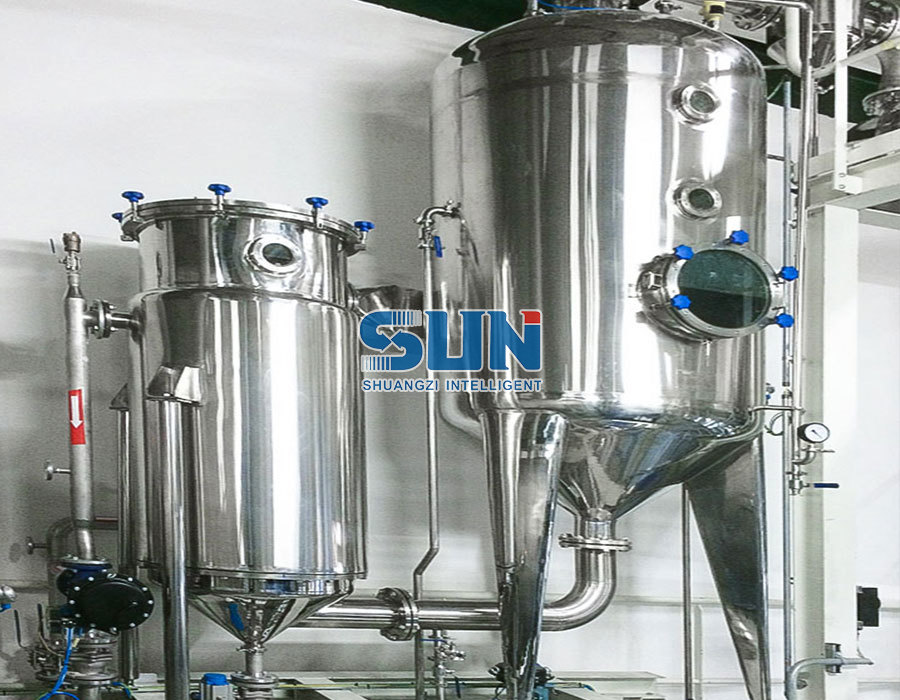
What Is Evaporation Concentration Equipment?
Industrial evaporation consumes roughly 18–25% of a typical processing plant’s total thermal energy budget. That single data point explains why the right equipment choice is never a commodity decision. Evaporation concentration equipment removes a solvent—almost always water—to increase the solids content of a liquid product. The goal can be volume reduction, value concentration, or solvent recovery.
The core challenge is heat transfer under conditions that minimize product degradation and energy waste. You’re not just boiling liquid; you’re engineering a phase change that must respect viscosity limits, heat sensitivity, and fouling tendencies. The equipment class spans radically different designs, from simple kettle evaporators to multi-stage mechanical vapor recompression systems.
Core Types of Evaporation Concentration Equipment
No single evaporator suits all applications. Each type solves a distinct combination of thermal sensitivity, operating cost, and capital investment. The five families below cover the vast majority of industrial deployments.
Falling Film Evaporators
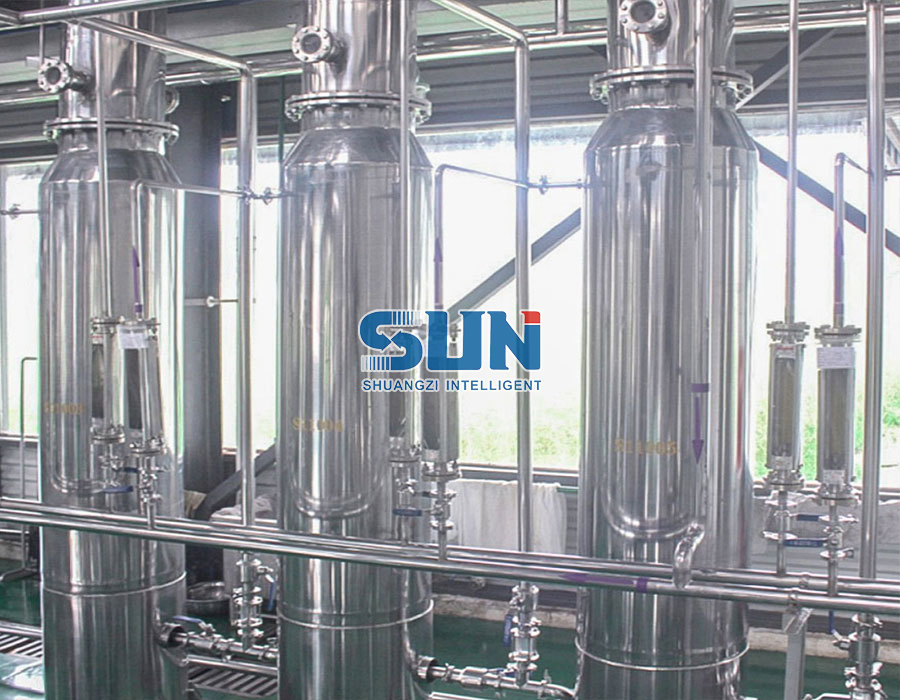
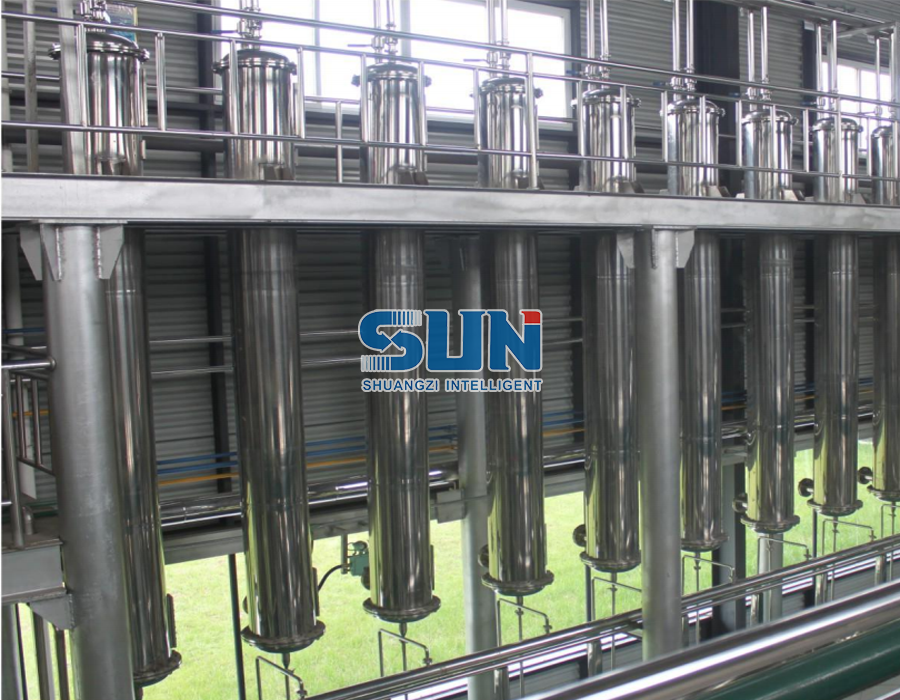
A thin liquid film flows down vertical tubes under gravity, while heating steam condenses on the shell side. Residence time is just a few seconds. That makes falling film units the default choice for heat-sensitive products such as fruit juices, dairy, and protein hydrolysates. High heat-transfer coefficients reduce the required surface area, and single-pass operation limits thermal history. For new plants processing heat-sensitive liquids, falling film evaporators often deliver the lowest product thermal load per unit of evaporation.
Forced Circulation Evaporators
When you deal with viscous, scaling, or crystallizing streams, gravity isn’t enough. A recirculation pump drives liquid through the heat exchanger at velocities of 2–4 m/s. This suppresses boiling inside the tubes and shifts vapor release to a separate flash chamber. The design extends run time between cleaning cycles and handles non-Newtonian fluids that would stall a falling film system. The trade-off is higher pumping energy and a larger liquid holdup.
Mechanical Vapor Recompression (MVR) Evaporators
MVR systems compress vapor produced in the evaporator and reuse it as the heating medium. Only a small electrical input powers the compressor or fan; the rest comes from latent heat recovery. Operating costs can drop by 70–90% compared to single-effect steam-heated units. Payback often lands inside two years where electricity prices are moderate and steam costs high. MVR evaporators now dominate new installations in dairy, ethanol, and zero-liquid-discharge plants, displacing multi-effect thermal designs unless steam is nearly free.
Scraped Surface / Thin Film Evaporators
A rotating wiper blade spreads the feed into a mechanically agitated film on a heated wall. The forced film renewal handles extreme viscosities—products that would burn onto a static surface. Typical applications include polymer devolatilization, gel concentration, and highly fouling nutraceutical extracts. Scraper evaporators trade higher capital and maintenance costs for the ability to process materials no other design can manage.
Multiple Effect Evaporators
By linking evaporators in series at progressively lower pressures, the vapor from one effect serves as the heating steam for the next. A triple-effect unit can evaporate roughly 2.5–3 kg of water per kg of steam, compared to under 1 kg in a single-effect. The number of effects becomes a direct capital-versus-energy decision. Above four or five effects, incremental efficiency gains often fail to cover the additional equipment cost unless fuel prices are exceptionally high.
| Type | Residence Time | Viscosity Limit | Energy Efficiency | Fouling Sensitivity |
|---|---|---|---|---|
| Falling Film | Seconds | Low–Medium | Medium–High | Low–Medium |
| Forced Circulation | Minutes | High | Medium | Low |
| MVR | Seconds to Minutes | Low–Medium | Very High | Low–Medium |
| Scraped Surface | Seconds | Very High | Medium | Very Low |
| Multiple Effect | Seconds to Minutes | Low–Medium | High | Medium |
Selecting the Right Evaporator: 5 Parameters That Decide the Outcome
The specification process starts with the product, not the hardware. Engineers who lead with equipment preferences instead of process data often end up with chronically fouled surfaces or excessive dilution water consumption.
1. Thermal Sensitivity
Proteins denature, flavors oxidize, and bioactive compounds degrade. If the target product requires exposure below 60°C for no more than 30 seconds, a vacuum falling film or MVR system becomes mandatory. For robust inorganic brines, a simpler forced circulation design may work at atmospheric pressure.
2. Viscosity Profile During Concentration
Many liquids thicken dramatically as water leaves. A feed that starts at 1 cP can easily exceed 500 cP at final concentration. Falling film units struggle above 200–300 cP; above that, the film distribution breaks down and dry patches form. Forced circulation or scraped surface designs handle the high-viscosity end without burning.
3. Fouling and Scaling Tendency
Calcium salts, proteins, and sugars precipitate as concentration rises. Evaporator type and flow velocity directly control the rate of deposit formation. Forced circulation’s high tube-side shear keeps surfaces cleaner longer. In contrast, a stagnant pool in a batch kettle guarantees rapid fouling. Run-length requirements often dictate whether the extra cost of a self-cleaning design is justified.
4. Target Final Solids and Eutectic Limits
Evaporation beyond solubility limits prompts crystal formation. If the process goal is a concentrated liquid, you stop before precipitation. If crystal production is the objective, a forced circulation crystallizer with an elutriation leg becomes the correct tool—not a generic evaporator.
5. Utility Costs and Site-Specific Economics
An MVR unit with a 500 kW compressor might save $400,000 per year in steam but demand $150,000 in electricity. The net benefit depends entirely on local energy prices. Multi-effect thermal systems favor sites with low-cost steam or waste heat. No single “most efficient” label holds across all regions.
Energy Efficiency: Where the Real Money Hides
Steam consumption is the largest operating expense for most evaporation plants. A single-effect thermal evaporator averages 1.1 kg steam per kg of water evaporated. A triple-effect cuts that to 0.35–0.40 kg/kg. MVR pushes equivalent thermal energy usage below 0.05 kg/kg when measured as primary fuel input, because electricity from a combined-cycle gas turbine carries roughly a 50% fuel-to-power conversion factor. The difference between a single-effect and an MVR system can exceed $50 per ton of evaporated water at typical industrial energy prices.
Preheating the feed with condensate and vapor waste streams is the simplest retrofit with a guaranteed rapid return. Mechanical vapor recompression is the next step, and integration with plant-wide pinch analysis can reveal opportunities to use low-grade heat that would otherwise go to a cooling tower.
Common Application Verticals
Evaporation concentration equipment appears wherever the value of a liquid stream scales with its solids content. Dairy plants concentrate whey and milk to reduce transport and drying costs. Fruit and vegetable processors turn 5–8 Brix juices into 65–70 Brix concentrates. Pharmaceutical extraction lines use gentle vacuum evaporators to capture heat-sensitive active ingredients without denaturation. Ethanol and solvent recovery systems combine evaporation with rectification to cut waste treatment volumes. Zero-liquid-discharge industrial wastewater systems rely on forced circulation and MVR evaporators to convert brine into distillate and a solid residue.
Each vertical demands a specific interplay of residence time, temperature, and cleaning protocol. A dairy falling film evaporator that works for whole milk will foul rapidly with high-acid whey unless the preheating and CIP sequence are redesigned. The equipment is not the whole answer; the process cycle around it matters equally.