
 英语
英语 俄语
俄语Content
A botanical extraction plant was producing excellent tinctures, yet every batch of final powdered extract failed moisture specification. The extractor, evaporator and centrifuge all performed well. The problem was the drying machine: a generic tray dryer that ran for nearly twenty hours, overheating the surface of each cake while leaving the interior still damp. This is not an unusual story in pharmaceutical, food, and chemical processing.
Conclusion first: the right industrial drying machine is the one that matches the material's moisture content, heat tolerance and required throughput, in that order. Comparing unit prices before understanding these three variables leads to a dryer that produces fine samples but fails under production load. This guide explains how to make that assessment correctly, covering the main dryer types, their typical applications, and the criteria that actually determine operating success.
Note that this article covers industrial drying machines for process manufacturing, not tumble dryers for laundry. The selection process is completely different: in an industrial setting, the dryer must preserve product chemistry, operate within tight temperature tolerances, and integrate with upstream extraction, evaporation or fermentation equipment.
Start with the Material, Not the Machine
Before looking at dryer models, define what is actually being dried. The physical and chemical properties of the feed determine which drying principles are viable at all.
Moisture content and physical form
Is the feed a solution, an emulsion, a paste, a slurry, a wet granule, or a filter cake? A spray dryer handles liquid feeds directly, converting them into powder in seconds. A vacuum belt dryer accepts pastes and wet granules that cannot be atomized. A tray dryer can handle nearly any solid shape, but at the cost of long residence times. If the feed form is fixed, this alone narrows the dryer type considerably.
Heat sensitivity and product quality requirements
The single most common reason drying projects fail is thermal degradation. Many plant extracts, pharmaceutical intermediates and fermentation products contain heat-sensitive actives that break down above fifty or sixty degrees Celsius. If your product is temperature-sensitive, the dryer must operate under vacuum to lower the boiling point of water, or use a very short residence time at elevated temperature. This is where the choice between spray, belt and continuous vacuum systems becomes a quality decision, not just a capacity decision.
Industrial Drying Machine Types: A Practical Comparison
Most process manufacturers eventually compare the following dryer families. Each has a distinct operating principle and a natural area of application.
| Drying machine type | Suitable feed form | Operating temperature | Typical industries |
|---|---|---|---|
| Centrifugal spray dryer | Solutions, emulsions, slurries | High inlet air, short contact time | Plant extracts, dairy, fermentation products, fine chemicals |
| Vacuum low-temperature crawler belt dryer | Pastes, slurries, wet granules | Low, via vacuum | Traditional Chinese medicine, food, botanical extracts |
| Vacuum low-temperature automatic continuous dryer | Granules, powders, pastes | Low, via vacuum | Pharmaceuticals, chemicals, food |
| Batch tray or oven dryer | Granules, cakes, solids | Medium to high | Low-cost batch operations |
For a more detailed look at how these machines serve different production segments, see our overview of drying machines for every industry. If you are deciding between thermal drying approaches, the comparison of a spray dryer versus a rotary dryer explains why the choice of atomization and contact time matters.
Vacuum Low-Temperature Drying for Fragile Products
When the active ingredient is heat-sensitive, vacuum low-temperature drying is the safest option. By reducing the pressure inside the drying chamber, the boiling point of moisture falls sharply. Water that would normally need 100°C to evaporate at atmospheric pressure can be removed at 40°C or lower under vacuum. This protects botanical actives, enzymes, vitamins, and pharmaceutical compounds that would otherwise degrade.
A particularly effective configuration is the full-automatic vacuum low-temperature crawler belt dryer. Material is spread evenly on a moving belt inside a vacuum chamber, where it passes through heated zones at controlled temperature. The continuous movement reduces residence time variability, and the full-automatic control system maintains stable drying conditions without manual intervention. This design suits pastes and wet granules originating from extraction lines, fermentation systems, or crystallization steps.
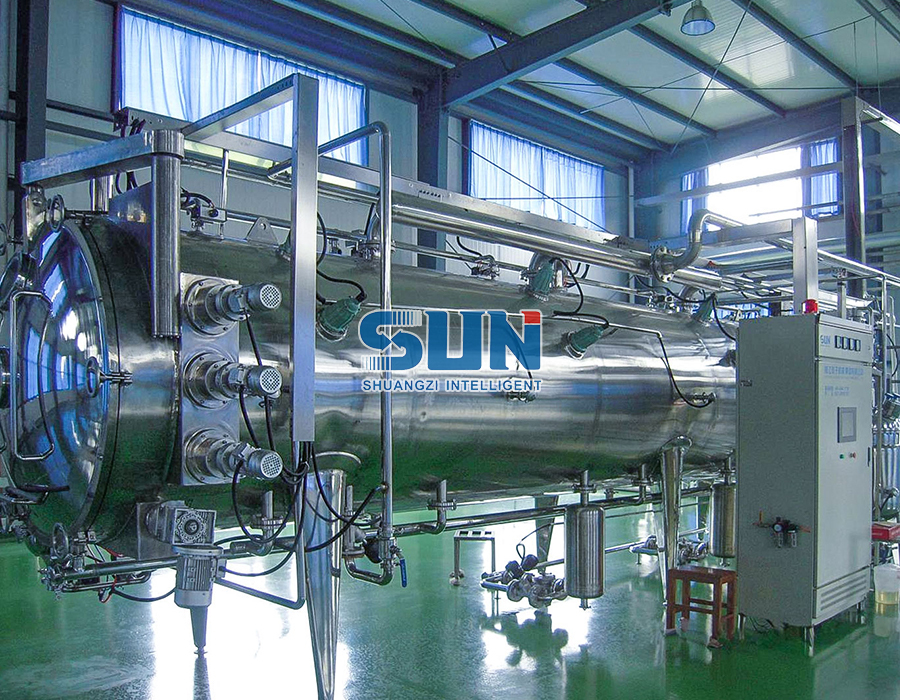 Custom Vacuum Crawler Belt Dryer Manufacturers, Wholesale SuppliersZhejiang Shuangzi Intelligent Equipment Co.,Ltd. is China vacuum crawler belt dryer manufacturers and custom vacuum crawler belt dryer su...View Product →
Vacuum drying also tends to produce better powder properties: lower residual solvents, higher bulk density, and more consistent particle structure. If your final product must meet pharmacopoeia moisture limits or strict food specifications, the ability to hold a stable low temperature across the entire belt is often the deciding factor.
Spray Drying for Liquid Feed
When the feed is already a liquid, spray drying removes the need for pre-concentration into a paste. A centrifugal spray dryer atomizes the liquid into fine droplets using a high-speed disc. The droplets meet hot air in the drying chamber and lose moisture within seconds, falling as dry powder. Because the residence time is so short, many heat-sensitive materials survive spray drying despite the high inlet air temperature.
Spray drying is common in plant extraction, where concentrated extract liquids are converted directly into powders for capsules, tablets, or instant beverages. It is also widely used in fermentation downstream processing, enzyme preparation, and the production of ceramic powders and pigments. The key advantage is that one machine replaces an entire evaporation-and-grinding sequence.
The main considerations are energy consumption and particle size control. Atomizer speed, feed concentration, and inlet temperature all influence final particle dimensions. A good spray dryer allows precise adjustment of these parameters, and the centrifugal atomizer design should be easy to maintain because it is the component that determines drop size.
Continuous Drying for High Throughput
For plants that need to run drying as a non-stop operation, a vacuum low-temperature automatic continuous dryer combines the product-protective benefits of vacuum with automation designed for production-scale throughput. Material enters continuously, moves through the drying zones mechanically, and exits with consistent residual moisture.
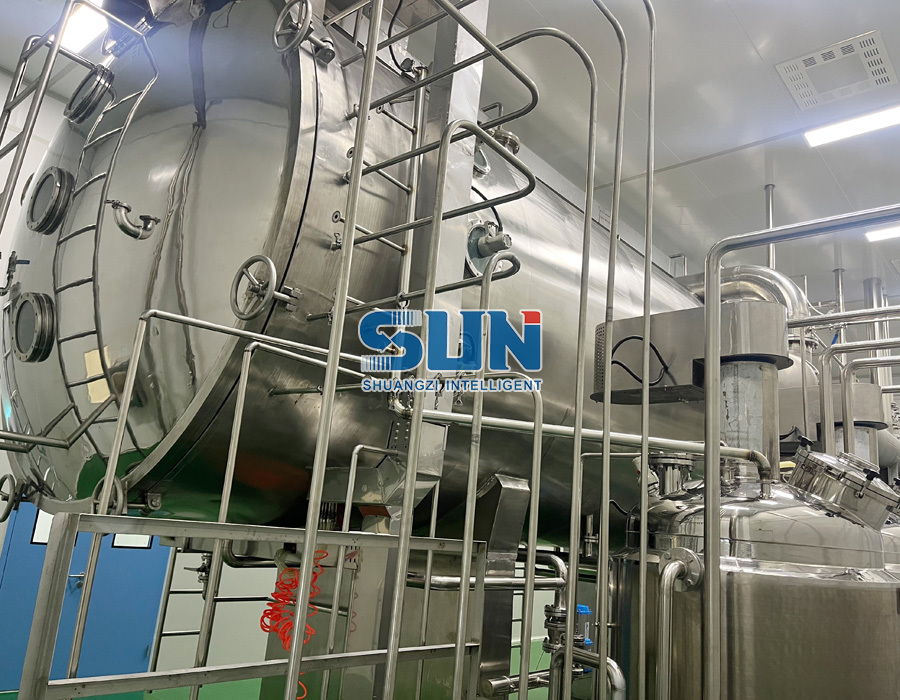 Custom Low Temperature Vacuum Belt Dryer for High Viscosity Paste Drying ManufacShuangzi Intelligent Equipment is China custom Low Temperature Vacuum Belt Dryer for High Viscosity Paste Drying Manufacturers and Wholes...View Product →
Continuous drying is particularly important when the dryer is part of a larger line, for example after extraction and evaporation, or before milling and sieving. Batch dryers create a stop-and-go rhythm that often overshadows the entire plant: operators wait for a load to finish, then rush to unload and reload. A continuous machine smooths that rhythm and reduces labor cost per kilogram.
An additional practical point is scale-up. Many manufacturers start with a laboratory dryer to develop their product, then need to translate those parameters to industrial equipment. A laboratory vacuum low-temperature crawler belt dryer is available for exactly this purpose, and the supplier's pilot workshop, designed to GMP requirements, can verify process conditions before full-scale commitment.
Energy Use, Cleaning, and Line Integration
Once the dryer type is fixed, operating cost and compliance decide the final specification.
Energy consumption cannot be judged by the nameplate
Two dryers with the same rated capacity can differ markedly in actual energy consumption. Vacuum systems consume power for the vacuum pump, the heating medium, and the condenser or solvent recovery loop. In practice, the more efficient designs use heat recovery, good insulation, and a condenser that captures solvents for reuse rather than venting them. If your process uses alcohol or other organic solvents, the solvent recovery capability of the dryer should be an explicit selection criterion.
Cleaning and GMP compliance
Pharmaceutical and food applications require easy access to all product-contact surfaces. Welded stainless steel construction with smooth finishing, minimal dead corners, and ideally clean-in-place arrangements are the practical details that determine whether a dryer passes audit and whether changeover between products is fast. SUS304 and SUS316L are the standard material choices, and the internal surface finish affects both cleaning efficiency and product release.
Finally, think about the dryer as part of the entire process rather than a standalone unit. The feed concentration coming from your evaporator, the temperature tolerance of your extracted actives, and the moisture specification required by your customer all affect the drying machine specification. Working with a supplier that understands the full extraction-concentration-drying chain helps avoid mismatched capacities between units. That is why many buyers choose to source drying machines together with evaporators, extraction tanks and separation equipment within one engineering package; our completed project references show how such integrated lines are delivered and commissioned.
Final Word
Choose an industrial drying machine by working backwards from the product quality you must guarantee. Determine the feed form and moisture, the maximum allowable temperature, and the throughput required for the line to be profitable. Then select the dryer family: a vacuum low-temperature belt dryer for fragile pastes and granules, a spray dryer for liquid feeds, or a continuous vacuum dryer for steady production-scale output. Avoid the common mistake of starting with the purchase price and working forwards; the cost of rejected batches and low line utilization will quickly exceed any initial saving.
If you are planning a new line or upgrading an existing drying step, a practical next step is to run a trial with your actual material under realistic conditions. Drying behavior is material-specific, and small-scale testing with the same equipment geometry is the most reliable way to confirm throughput, residual moisture, and product quality before investing in production-scale machinery.