
 英语
英语 俄语
俄语Content
- 1 What TFF Filtration Is and Why Flow Direction Changes Everything
- 2 The Parameters That Decide TFF Performance
- 3 Concentration and Diafiltration, the Two Workhorse Modes
- 4 Where TFF Sits in an Industrial Production Line
- 5 Membrane Formats: Cassette, Hollow Fiber, or Spiral Wound
- 6 Fouling, Cleaning, and the Numbers Worth Watching
- 7 TFF or Evaporation? Usually Both
- 8 Questions to Settle Before You Buy
If you have ever watched a dead-end filter blind within minutes on a protein lysate or a viscous botanical extract, you already understand the problem TFF filtration was engineered to solve. Tangential flow filtration pumps the feed across the membrane surface instead of straight into it, so the sweeping flow continuously carries away the solids that would otherwise build a clogging cake. The short version: choose TFF when you need to concentrate, wash, or buffer-exchange a heat-sensitive product at a stable flux, and treat it as one unit operation inside a production line that still needs clarification, evaporation, and drying equipment around it.
What TFF Filtration Is and Why Flow Direction Changes Everything
TFF filtration, also known as cross-flow filtration, is a pressure-driven membrane separation process. Feed liquid is pumped parallel to a semi-permeable membrane. Transmembrane pressure pushes a portion of the liquid, the permeate, through the pores, while the retained stream, the retentate, keeps circulating past the surface. Because this crossflow shears the boundary layer clean, the system holds a comparatively stable flux for hours. Normal flow filtration (NFF) drives the entire feed volume into the media instead; resistance climbs as a cake forms, and throughput decays until the cartridge is replaced.
Three practical consequences follow from this geometry:
- The membrane acts as a sieve, not a depth trap, so selectivity is set by pore size or molecular weight cut-off (MWCO) rather than by media thickness.
- Recirculating the retentate lets you decide how concentrated the product becomes, independent of the starting batch volume.
- The same membrane can usually be cleaned in place and reused across batches, shifting costs from consumables toward capital, pumps, and labor.
The Parameters That Decide TFF Performance
Four variables dominate every TFF trial, and they interact: raise one and you usually compromise another. A workable starting window looks like this:
| Parameter | Typical starting range | What it controls |
|---|---|---|
| Transmembrane pressure (TMP) | 0.3 - 2 bar | Driving force for permeate flow; excess pressure compacts the fouling layer |
| Crossflow velocity | About 1 - 5 m/s at the surface | Sweeping action that limits cake build-up; higher values add pump shear and heat |
| Membrane MWCO | 3 - 5x tighter than the target molecule | The cut-off between retained product and passing salts, solvents, and small impurities |
| Flux (LMH) | Roughly 10 - 80 for ultrafiltration duties | Liters per square meter per hour; the number that sizes the system |
MWCO selection deserves special attention. Retention at the stated cut-off is only partial, so experienced teams choose a membrane 3 to 5 times tighter than the molecule they intend to keep; a 150 kDa protein would call for a 10 to 30 kDa membrane. A tighter membrane protects yield but costs flux, and only a pilot run on your actual feed settles that balance.
Concentration and Diafiltration, the Two Workhorse Modes
Almost every TFF run is one of two operations, or the two stitched together.
Concentration
Permeate leaves the loop while retentate returns to the feed tank, so volume shrinks and the retained product thickens. Volume concentration factors of 5 to 10 times are routine for protein solutions, all at near-ambient temperature with no phase change, which is precisely why heat-sensitive biologics favor the method.
Diafiltration
Wash buffer or water is added to the retentate at the same rate permeate is removed, so volume stays constant while small molecules wash out: salts, ethanol, sugars, free phenolics, or an old buffer you need to exchange. In continuous diafiltration, each wash volume leaves roughly 37 percent of the original contaminant load behind, so five diavolumes remove more than 99 percent. Most industrial recipes concentrate first, diafilter at the smaller volume, then concentrate again to the final solids target.
Where TFF Sits in an Industrial Production Line
TFF almost never operates alone. In botanical, fermentation, and biopharmaceutical plants it slots into a fixed sequence:
- Extraction or fermentation produces the crude liquor.
- Primary clarification with a decanter or disk centrifuge, sometimes backed by a depth filter, removes cells, fibers, and resin fines.
- TFF concentrates the clarified liquor and washes out solvent, salts, and low-molecular impurities.
- The retentate moves on to chromatography, crystallization, final concentration, or drying.
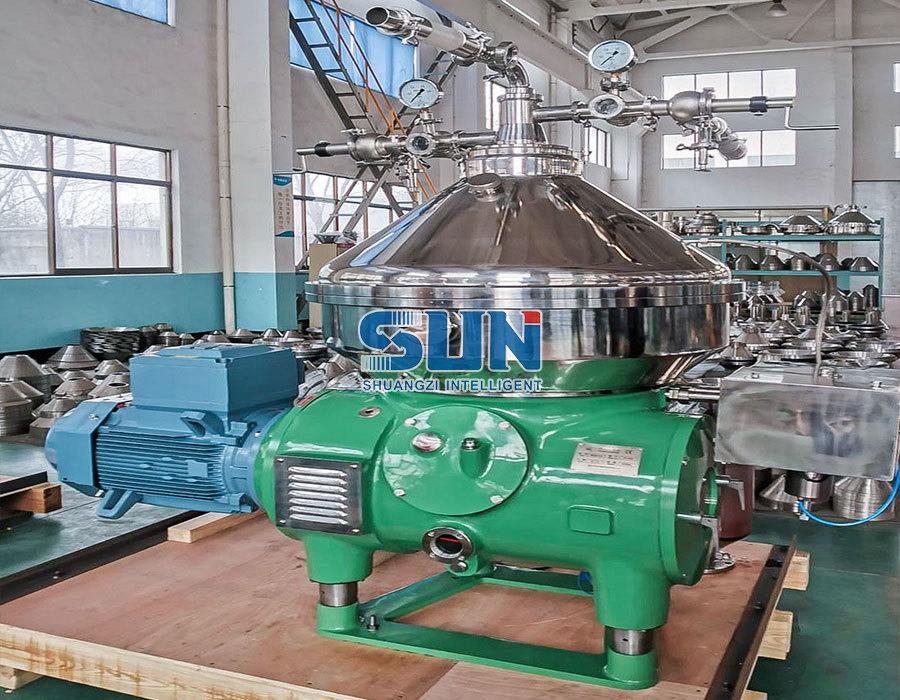 Vertical Disc Stack Centrifuge Separator for Biological Liquid Herb Extract Solid-liquid SProduct description:View Product →
Skipping the clarification step is the most common reason TFF trials disappoint. Particles that a centrifuge removes in minutes will blind a membrane in the same number of minutes, and no crossflow setting rescues a feed full of waxy resins or cell debris.
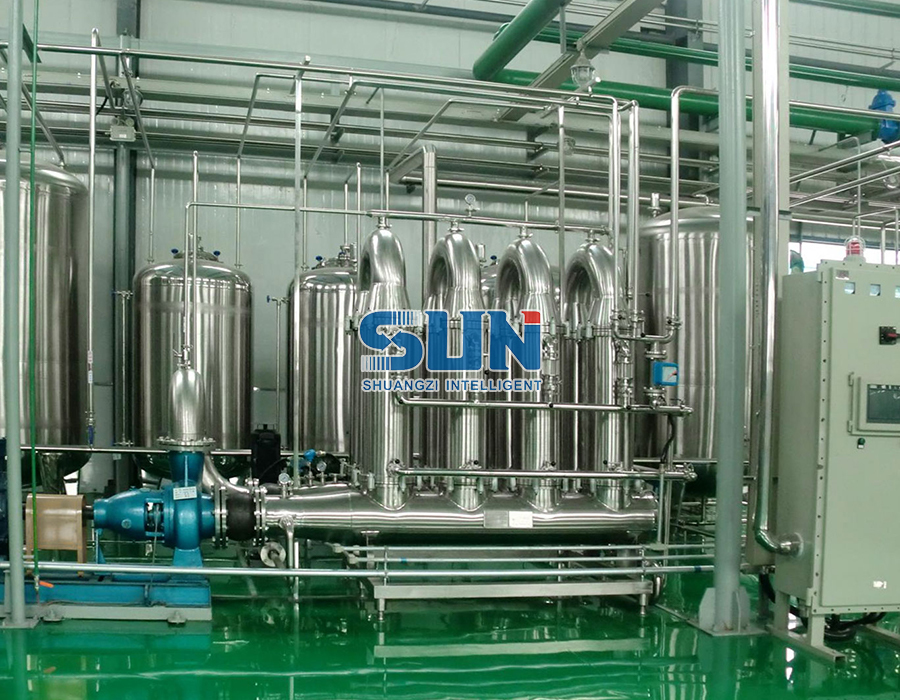 Plant Extraction Supporting Membrane Separation EquipmentFiltration process line: Circulation tank → Feed pump → Ceramic membrane → Filtrate ↑ ↓ ——————————————————ConcentrateView Product →
Integration matters as much as membrane choice: tank geometry, pump shear, TMP control, and clean-in-place design decide whether the unit runs for eight hours or eighty. Teams building complete lines generally prefer suppliers who can deliver the centrifuge, the membrane skid, the evaporator, and the dryer as one engineered package, as in this CBD oil and CBD isolate extraction production line in Northeast China.
Membrane Formats: Cassette, Hollow Fiber, or Spiral Wound
- Flat-sheet cassettes: high membrane area per unit volume and predictable linear scale-up; the default for protein ultrafiltration and diafiltration.
- Hollow-fiber modules: open, uniform channels that tolerate particles and low shear, which suits cell harvesting, virus clarification, exosome work, and viscous plant extracts.
- Spiral-wound elements: the lowest cost per square meter, widely used at industrial scale when the feed is already well pre-filtered.
Membrane chemistry matters as much as format. Polyethersulfone is the general-purpose choice for protein work; regenerated cellulose reduces adsorption where product loss at the surface is a concern; solvent-stable polymers are mandatory when the feed still carries ethanol or other organics, a frequent situation in botanical processing.
Fouling, Cleaning, and the Numbers Worth Watching
Flux decline comes from three usual suspects: concentration polarization at the membrane surface, formation of a gel or cake layer, and adsorption of solutes into the polymer. Practical countermeasures, in order of cost:
- Run at the lowest TMP that reaches your target flux; excess pressure only compacts the fouling layer.
- Raise crossflow before raising pressure.
- Add backwashing or backpulsing on microfiltration duties such as cell-debris removal.
- Consider alternating tangential flow, where an oscillating diaphragm reverses the crossflow, for long fermentation harvests.
- Standardize a clean-in-place sequence of caustic wash, rinse, and sanitize, and record normalized water permeability after every cycle; when NWP no longer recovers enough to hit flux targets, the membrane is due for replacement.
TFF or Evaporation? Usually Both
Buyers often ask whether membrane concentration replaces evaporation. In practice the two share a line rather than compete for it.
TFF wins where heat is the enemy: protein solutions, enzymatic products, aroma-sensitive extracts. It concentrates without boiling, washes simultaneously, and leaves no thermal-degradation marker. Its limits are viscosity and solids; past roughly 15 to 20 percent dry solids, or with heavy particle loads, flux collapses.
Evaporation wins on bulk solvent removal. Pulling ethanol off an extract, recovering it for reuse, or taking a feed from 5 to 40 percent solids is evaporator territory, and modern MVR designs recompress vapor to cut steam consumption dramatically.
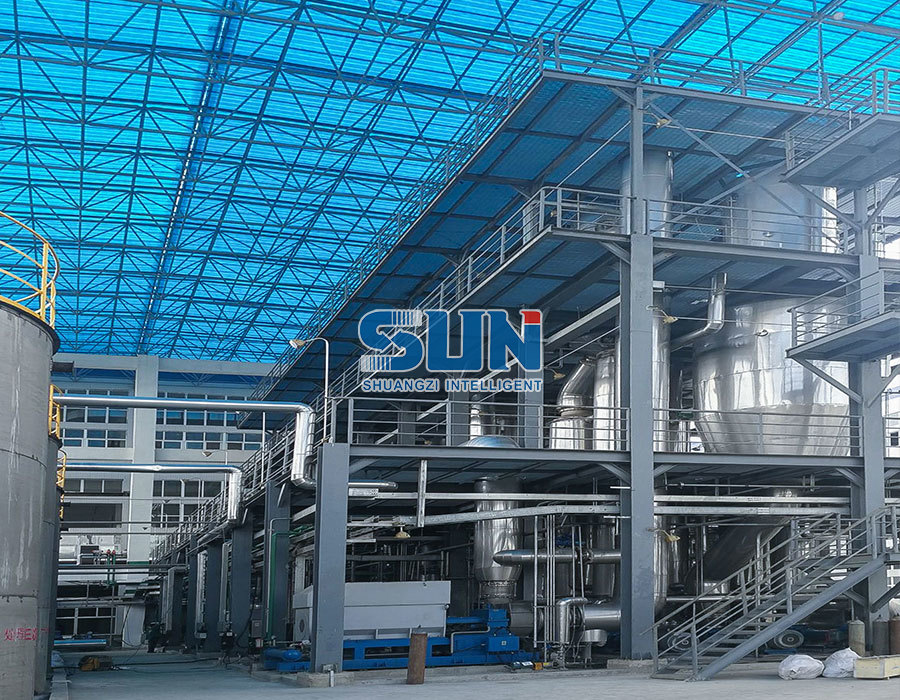 MVR Evaporator for Energy-Saving Solvent RemovalThis mechanical vapor recompression evaporator recovers secondary steam latent heat to cut external energy demand during bulk solvent removal. It pairs with tangential flow filtration, which handles gentler final concentration and buffer exchange.View Product →
A sensible split: the evaporator handles cheap bulk removal and solvent recovery, while TFF finishes the process with a gentle final concentration and buffer exchange. For the thermal side of that decision, this evaporation and concentration equipment selection guide compares the main evaporator types and their efficiency ranges.
Questions to Settle Before You Buy
- Pilot the real feed. Surrogate solutions hide the fouling behavior that decides project economics.
- Confirm the scale-up rule. Membrane area should scale linearly with throughput; ask the vendor to show pilot-to-production data.
- Check materials and documentation. SUS316L product-contact surfaces, sanitary welds, and GMP paperwork matter in pharma and food applications.
- Demand real control. Automated TMP management, permeate back-pressure valves, and data logging separate a production skid from a lab toy.
- Price membranes over their lifetime, including CIP chemicals, water, labor, and replacement interval, not just the invoice.
Handled this way, TFF filtration is a dependable, scalable workhorse: match the membrane to the molecule, protect it with honest clarification, manage fouling with data rather than guesswork, and let evaporators and dryers do what they do best around it.