
 英语
 俄语
Content
What upstream and downstream processing actually covers
Upstream processing grows the product; downstream processing makes it saleable. Upstream spans cell bank and media preparation, inoculation, culture or fermentation, and harvest. Downstream begins with the harvested broth and ends with a released, packaged product.
Where exactly the line is drawn matters less than the interface. Most practical difficulty concentrates at harvest, where a living, variable upstream stream meets equipment designed for steady, predictable feeds.
| Dimension | Upstream | Downstream |
| Primary objective | Build biomass and target molecule | Recover and purify to specification |
| Typical operations | Media prep, inoculation, fermentation, harvest | Clarification, concentration, purification, drying |
| Dominant cost driver | Media, seed train time, utilities | Yield loss, solvent and energy use, consumables |
| Main quality risk | Contamination, titre drift, oxygen limitation | Degradation, impurity carryover, batch variation |
| Key scale-up variable | Heat removal and oxygen transfer | Residence time, viscosity and pressure drop |
| Success metric | Volumetric productivity | Recovery yield and final purity |
A ten percent gain in titre upstream is easily erased by a five percent yield loss at clarification. Operators often miss it because the two numbers are reported by different departments in different units.
Upstream: from a working cell bank to a reproducible feed stream
An upstream process is only as good as its worst repeatable run. A record titre in one batch means little if the next three drift by fifteen percent, and downstream equipment inherits every one of those swings.
Seed train and inoculation
Inoculum volume is commonly set at 5 to 10 percent of the production vessel working volume. A shorter seed train reduces contamination exposure but demands higher inoculum density, and that trade-off is decided long before the production vessel is specified.
Media, feeds and oxygen transfer
Dissolved oxygen is the parameter that most often blocks scale-up. A 2 m3 vessel may hold 30 percent saturation comfortably while a 20 m3 vessel with identical impeller geometry struggles, simply because oxygen transfer falls as liquid height rises. Feed strategy, pH control and antifoam dosing all interact with that ceiling.
Instrumentation that pays for itself
Temperature, pH, dissolved oxygen, off-gas composition and foam detection are the working minimum. Off-gas analysis turns a fermentation run into a measurable carbon balance, which shortens development time and hands downstream engineers a realistic feed composition instead of an average.
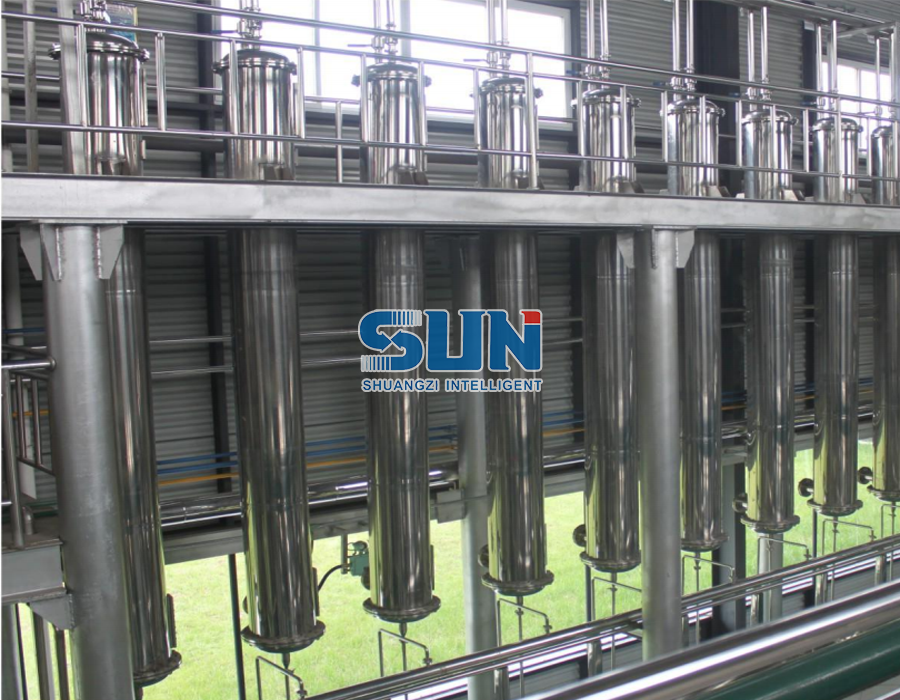
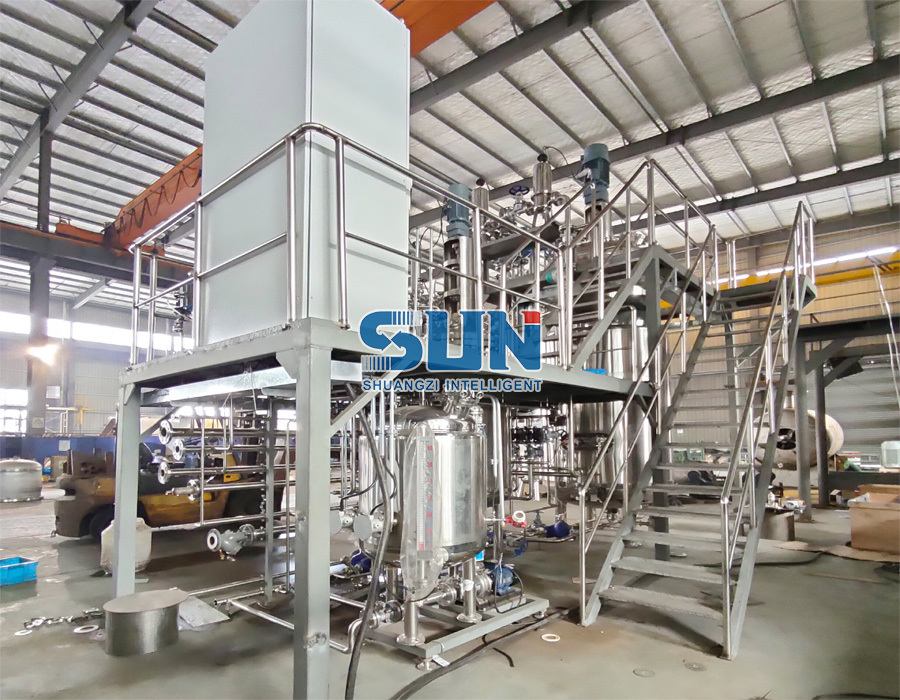 Custom Three-Stage Trichoderma Fermentation SystemA custom three-stage fermenter for Trichoderma cultivation, with 50–5000 L capacity and temperature/pH control for reproducible fermentation runs.View Product →
Downstream: where recovery yield is won or lost
Downstream processing turns a dilute, contaminated broth into a specification-grade product, and on most lines it carries the larger share of both capital and operating cost. Every unit operation trades yield for purity, so the sequence, not the individual machine, decides the economics.
Clarification
Disc-stack centrifuges, decanters and membrane filtration remove cells, debris and suspended solids. Throughput and bowl discharge interval usually matter more than a headline g-force figure.
Concentration
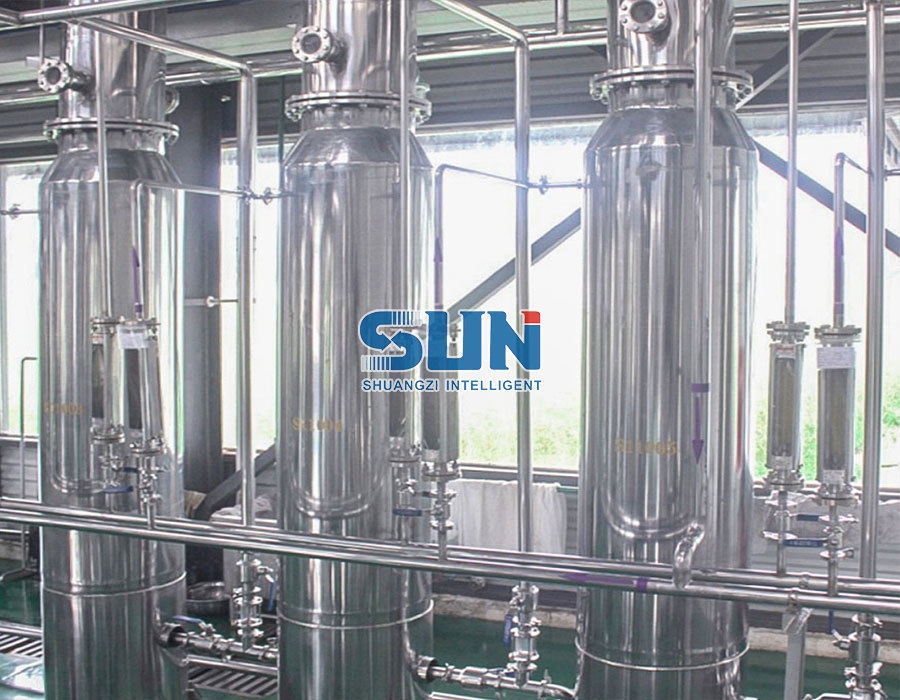
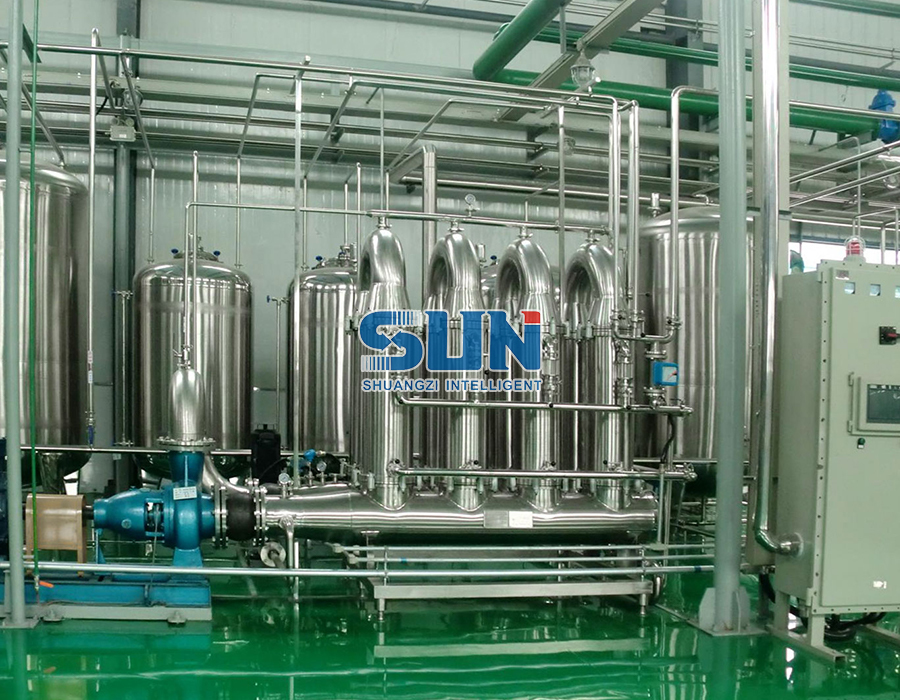
Falling-film evaporators, MVR units and ultrafiltration cut water load before purification. Running under vacuum keeps heat-sensitive actives inside specification.
Purification
Solvent extraction, chromatography, distillation or molecular distillation separate the target from structurally similar impurities. Selectivity at this step sets the purity ceiling for the whole plant.
Polishing and drying
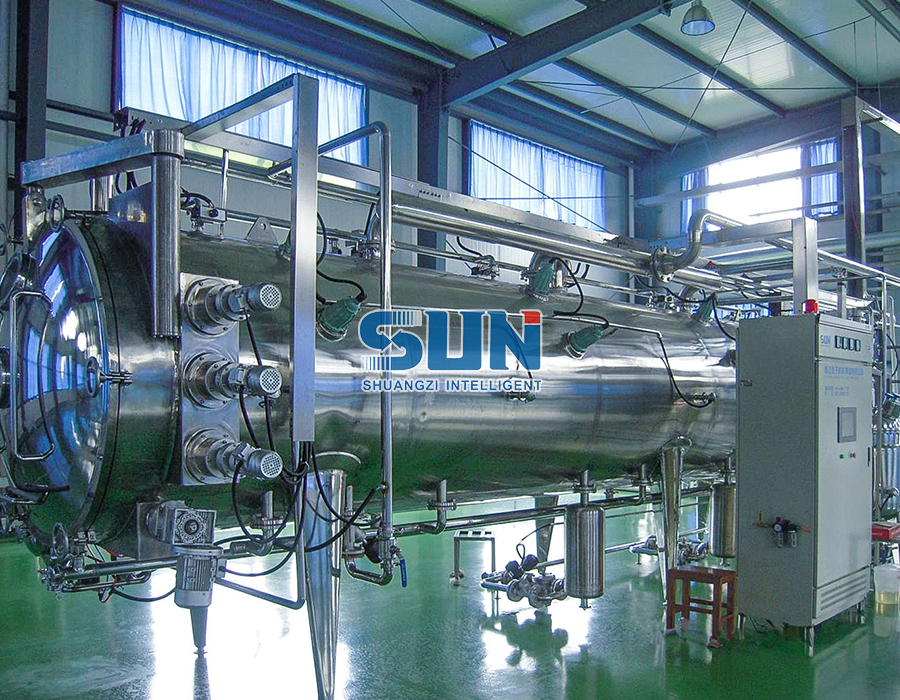
Crystallisation, vacuum belt drying or spray drying fix the final form. Residual solvent and moisture specifications are decided here, not at release testing.
Materials follow the chemistry. SUS316L wetted parts, sanitary welds and CIP/SIP capability are baseline for pharmaceutical and food-grade duty, while solvent service adds explosion protection, vapour recovery and stricter electrical classification.
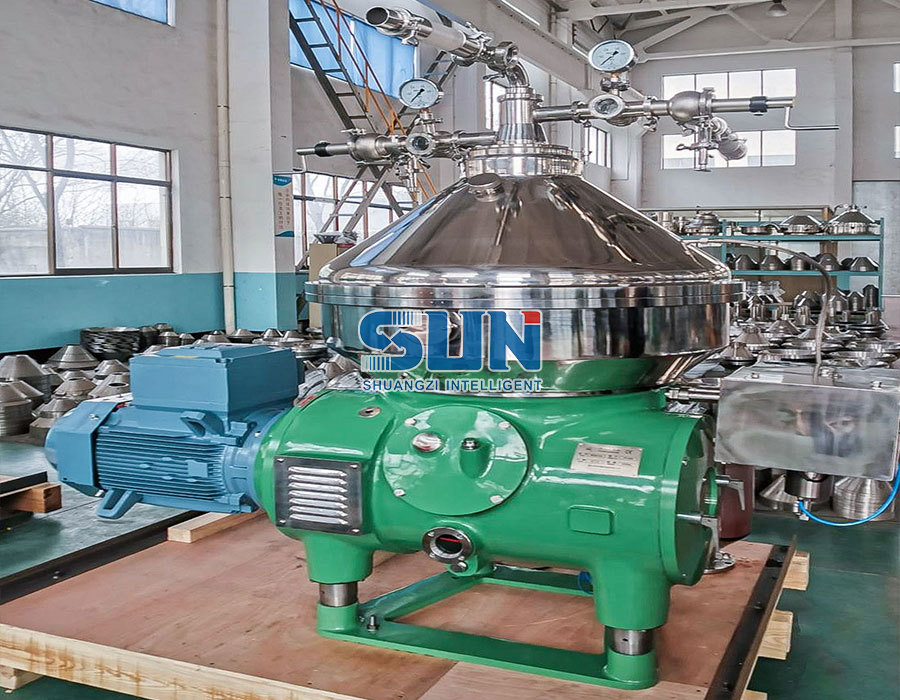 Vertical Disc Stack Centrifuge for Herbal Extract SeparationA vertical high-speed separator for herbal extracts and fermentation broth, with stainless-steel contact parts and capacities up to 20,000 L/H.View Product →
Where the two halves collide
Most friction between upstream and downstream is created in one half and paid for in the other, usually through oversized equipment bought late to fix an interface nobody owned.
Upstream choices that raise downstream cost
- Extended fed-batch runs that push solids load past the centrifuge duty
- Complex media whose ligands co-purify with the target
- Antifoam doses that foul membranes and shorten cartridge life
- Harvest timing driven by schedule rather than by broth quality
Downstream limits that should reshape upstream design
- Clarification capacity and minimum discharge interval
- Solvent recovery duty and evaporation energy per kilo
- Buffer and purified water consumption per batch
- Product stability window between harvest and first purification
From pilot to production without rebuilding the line
Pilot data transfers cleanly only when geometry, residence time and materials stay consistent between scales. A process proven in a 100 L vessel with a different impeller and a shorter residence time is a different process, not a smaller one.
Turnkey delivery works when process design, fabrication, installation and commissioning sit under one scope. That is the practical argument for EPC and EPCM contracting: one mass balance, one set of piping and instrumentation drawings, and one party accountable when the clarification train cannot keep pace with the fermenter. Buyers comparing quotes should check whether the scope covers automation, utility sizing and validation documents, not only the equipment list; a short brief on turnkey project scope is worth reading before the technical bid review.
Botanical lines follow identical logic at higher solids loadings. A Taxus chinensis extraction line built for a Belgian customer combined extraction, concentration, separation and drying in a single sequence, which is the honest test of whether both halves were designed together or merely bolted together.
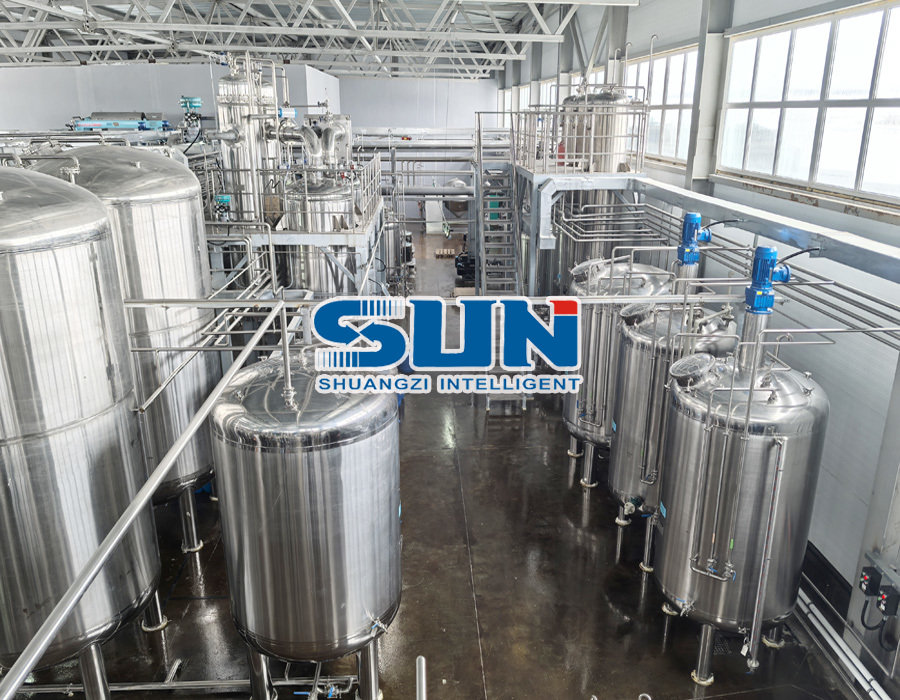 Plant Extraction Equipment and Turnkey Production LinesA category overview of extraction machines and turnkey lines for pectin, Chinese herbs, tea polyphenols, astaxanthin, rosemary and curcumin.View Product →
Frequently asked questions
What is the difference between upstream and downstream processing?
Upstream produces the target molecule through controlled growth or biosynthesis, while downstream recovers and purifies it to specification. Upstream governs titre and reproducibility; downstream governs recovery yield and final purity.
Which half costs more to build and run?
On purification-heavy lines downstream usually takes the larger share of process capital and dominates solvent, energy and consumable spending. Upstream tends to carry the heavier utilities load and the longer campaign risk.
Why does downstream often limit plant capacity?
Because separation equipment is sized on solids load, viscosity and residence time rather than titre alone. Raising titre without upgrading clarification simply relocates the bottleneck to a different room.
Can a single supplier cover both halves?
Yes, and it lowers interface risk. One integrated scope keeps mass balance, control philosophy and validation documentation aligned, which is difficult when two vendors each optimise only their own section of the line.
Upstream and downstream processing form one system with two cost centres. Treat the harvest point as a design interface rather than a handover, and the line is far more likely to hold its promised capacity long after commissioning.